// case study · our own product
SanAlert
Unofficial early warning about air threats over Poland, with a level for the place you choose.
// the problem
One answer,
for one place
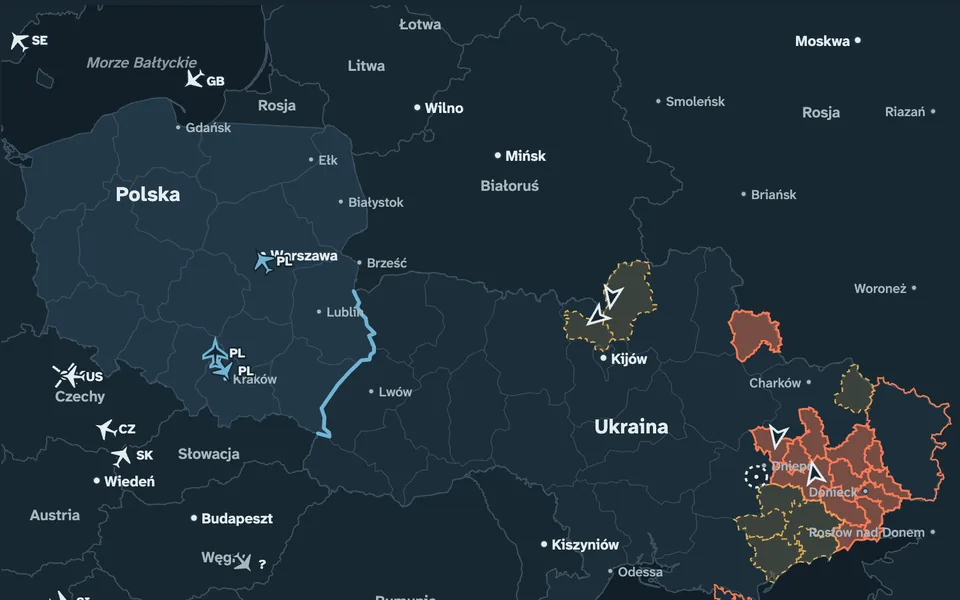
SanAlert shows an unofficial threat level from the air for places in Poland: drones and missiles tracked across the border, a level for the place you pick, and the official RCB and RSO messages in their original wording.
A warning like that has to do three things. It has to answer for one place, not for a region. It has to be where people already look: a phone, a watch, a home dashboard, an assistant. And it must never come out weaker than it went in.
// what we built
The same level,
everywhere
- A web app and native apps for iPhone, Mac, Android and Wear OS.
- A Home Assistant integration, so a home can react to the level for its own location.
- Two servers for AI assistants. A remote one answers for the whole country. A local one runs on the user’s computer and answers for one place.
- Official messages, unedited. RCB and RSO messages are shown in their original wording.
// the design
The decisions
that matter
- The place never reaches us. The local server downloads the same public state the website reads, finds the place on a grid of Poland and reads the level locally. No request it makes carries the place. It also refuses to look a town name up online, because that would send the place to whoever runs the lookup.
- No data is never quiet. When the state is missing, cannot be read or is older than 60 seconds, the answer is “no data” with the reasons, never “quiet”. A point outside Poland is “out of range”.
- A warning cannot be softened. Every answer carries the sentence the website shows under the level. The assistant is told to repeat the level and that sentence as they are, and never to call a place safe.
- One set of rules. The local server does not compute the level with new code. It uses a byte-for-byte copy of the Home Assistant integration’s code, and CI fails if the two ever differ.
// the numbers
What can be counted
// what was hard
The bug
a review found
The age of the state came from the computer’s clock. With the clock two hours behind and the API down, the last “quiet” would have looked fresh for two hours.
A separate review found it before the merge. Now the age is never less than the time the server has held the document. The same gap existed in the Home Assistant integration and was fixed there too.
// read more
The long version
// get in touch
Have a problem that
needs shipping?
kontakt@appliedai.dev
We read everything. Serious problems get a reply from an engineer, not a funnel.