// case study · product
FormFlow
Contact forms that brands run without developers. Because every submission comes through the form, every attached photo is checked.
// the problem
A new form field should
take a minute
A company with many brands runs dozens of contact forms. Every change is a ticket to developers and a wait for a deployment, and submissions land in a shared mailbox where someone works out by hand which brand and which topic they concern.
The form and the attached photo live in separate places, so nobody checks the photo.
// what we built
Forms the quality team
runs itself
Build the form
- A draft from a template, a blank form or a copy of an existing one.
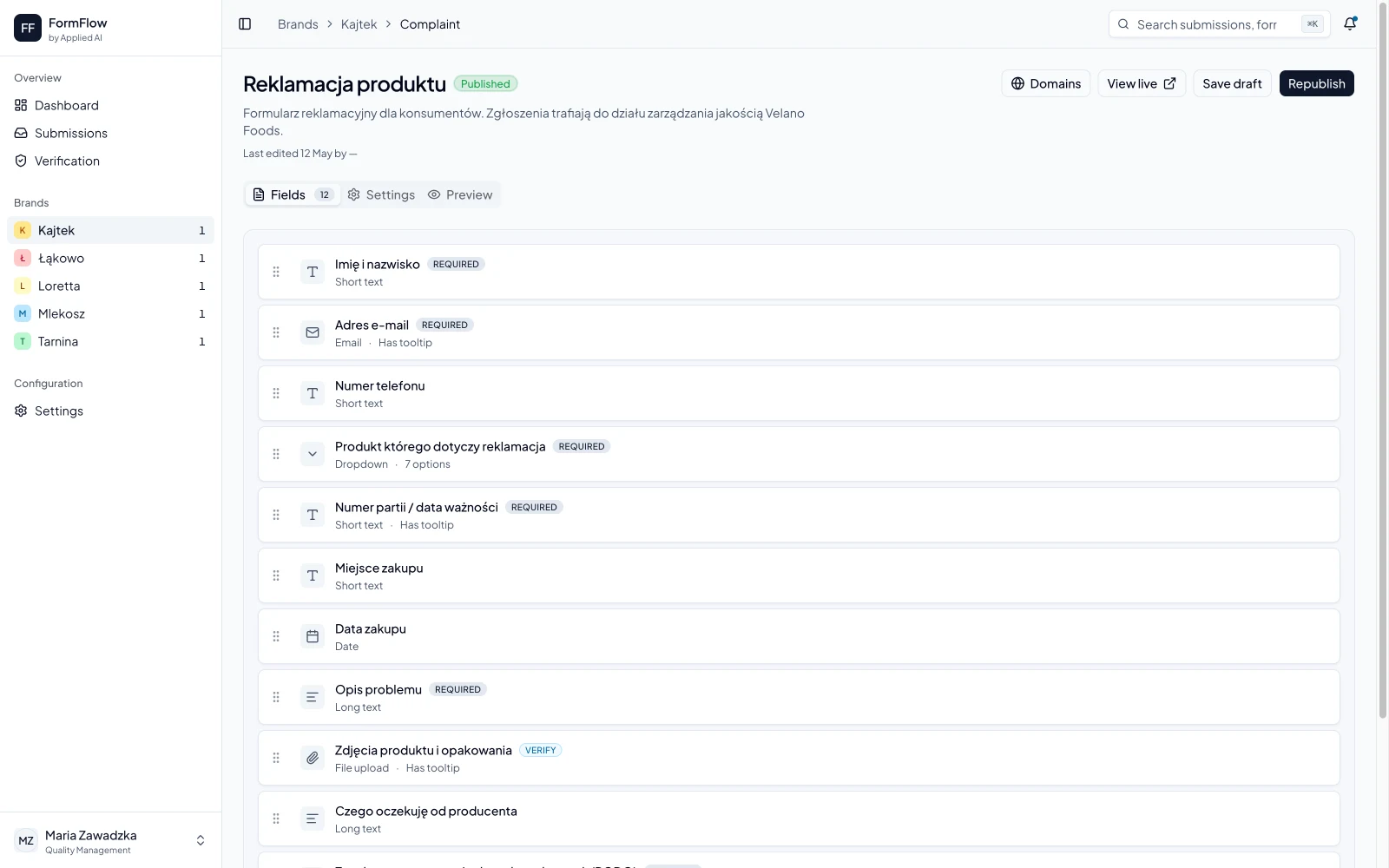
- Twelve field types. Order, required rules, validation and hints are set from the panel by someone non-technical.
- Steps and conditional fields, a look of its own for each brand, and up to 20 content languages.
Test and publish
- The public form always serves the published version. Earlier versions stay in the history and can be restored as a draft.
- A test run in a preview that sends and saves nothing, and a review of what changed before every publication.
- On the brand’s own domain, or embedded in an existing page.
Receive and handle submissions
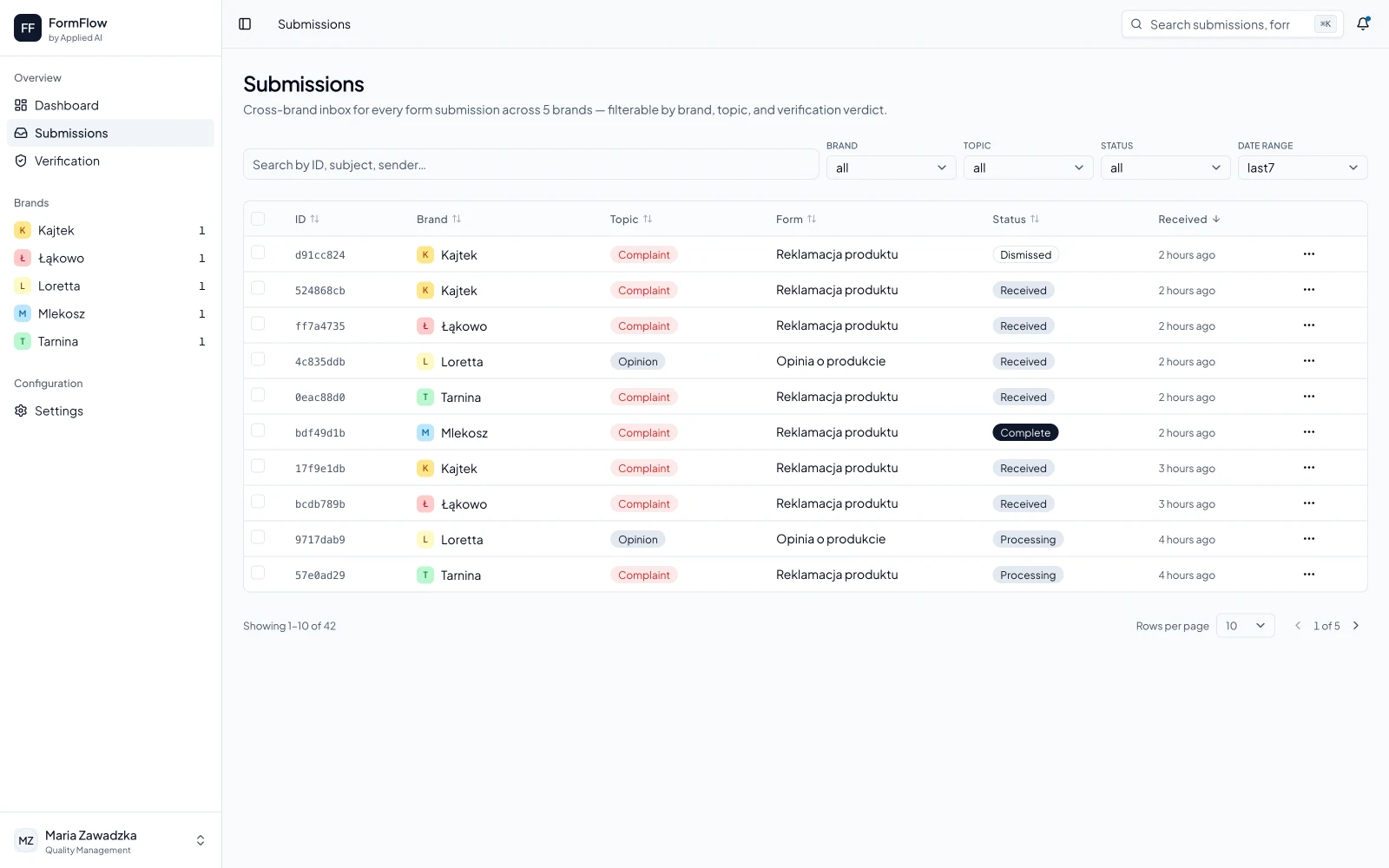
- Each submission arrives labelled with its brand, topic and recipients. Routing rules send different answers to different teams.
- One list of submissions for every brand, with search, filters and CSV export.
- Every submission is kept with the form version it was filed under.
- Five roles, signed webhooks and an API.
And every photo is checked
Because every submission comes through the form, every attached photo gets three independent checks before anyone makes a decision. The reviewer sees a verdict together with the material behind it, not a bare number.
// the stack
How it is delivered
A panel for the quality team, public forms served on the brands’ domains, and the checks behind them. The whole system runs inside the client’s infrastructure (on-premise, installed with Helm) or as a managed service, with OIDC single sign-on, including Microsoft Entra ID.
// the numbers
What can be counted
There are no production figures we can publish yet. What can be counted today is the product.
// what was hard
Where it
pushed back
- Forms change, cases do not. A complaint has to be readable a year later against the form as it was when it was filed. So every submission keeps the version it was filled against, and publishing shows exactly what changed.
- Non-technical editors, production forms. People with no developer behind them publish to live brand sites. Drafts, a test run that sends nothing and a review before every publication are what make that safe.
- A photo as evidence. A photo attached to a complaint moves through an organisation without anyone examining it. Putting the check in the form means it happens to every photo, not only to the ones somebody remembered to look at.
// read more
More on FormFlow
// get in touch
Have a problem that
needs shipping?
kontakt@appliedai.dev
We read everything. Serious problems get a reply from an engineer, not a funnel.
